


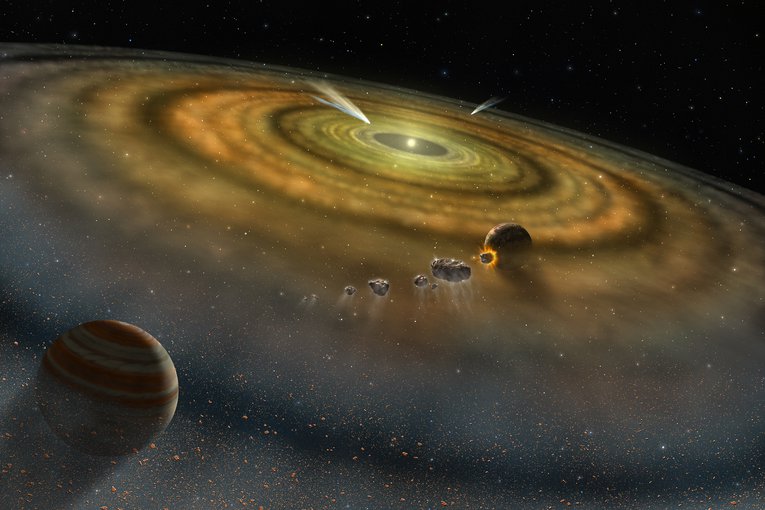
Our solar system more or less originated like this: a big cloud of gas and dust collapsed under the force of gravity, with the Sun forming at its centre. Around it, a rotating disc formed, within which the remaining material coalesced into planets, moons, and other celestial bodies.
Although we roughly know how our solar system formed, other galaxies with planets often look very different. This shows that planet formation does not proceed in the same way everywhere. Researchers conclude that, in addition to the initial conditions, random processes also play an important role in the formation of Earth-like planets.
No rocks remain from the earliest Earth (during the Hadean era, from 4.56 to 4 billion years ago) that would allow researchers to determine the Earth’s earliest composition. What is possible, however, is to use astrophysical models to calculate the possible composition of volatile substances (such as water, CO₂ and other gases) that the early Earth might have had. This possible composition serves as a starting point for understanding how rocky planets developed in the beginning, when they still consisted of a hot magma ocean.
In this project, researchers are combining computer models to simulate how rocky planets form within a disc of gas and dust around a young star. In doing so, they are examining how dust and pebbles clump together to form planets, how these move, how gravity works, and how the chemical composition changes during this process.
The aim is to understand how Earth-like planets form and what chemical compounds they acquire.