


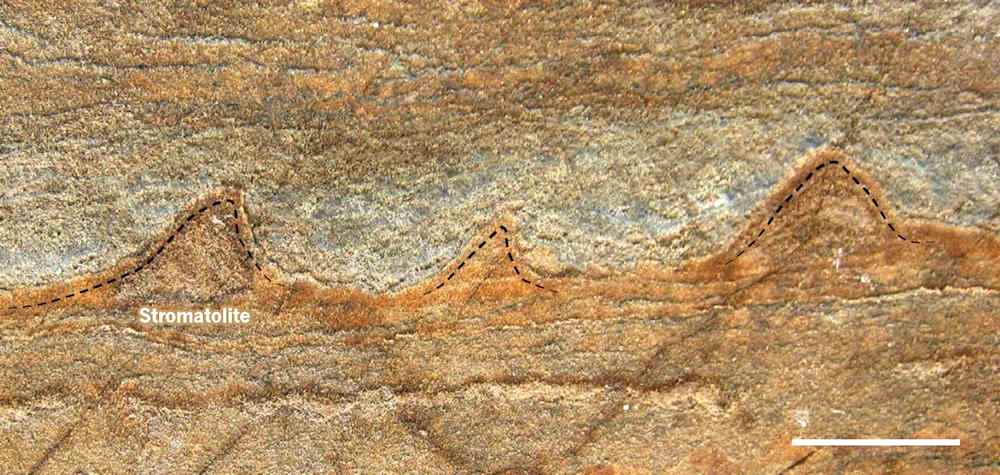
Determining in what environment the oldest microfossils existed and how they lived leads to a better understanding of the origin of life. This can only be achieved if we can confidently differentiate these oldest microfossils from structures that were formed without the need for life, but that look a lot like them. With the earliest life forms, that is especially challenging, because differences are often small.
There are different criteria for identifying ancient microfossils, but there is as yet no consensus on the oldest examples. In recent years, researchers have increasingly been using measurements of shape and structure, and analysing images and forms to record differences in morphology (the shape and structure of something).
Recently, Topological Data Analysis (TDA) has also been used to distinguish between biological structures and abiotic (non-living) forms. TDA methods involve analysing data by examining the ‘shape’ and structure of patterns. This technique is not image analysis in itself, but uses mathematical methods to analyse patterns in image data.
Unlike machine learning, TDA methods are generally easy to follow and understand, rather than being a ‘black box’ where you cannot see exactly how the result is produced. Moreover, these methods do not require large amounts of training data to work effectively.
The goal of this project: employ TDA to develop a quantitative test that can determine whether or not a set of morphological features is of biological origin.